General
Data labeling
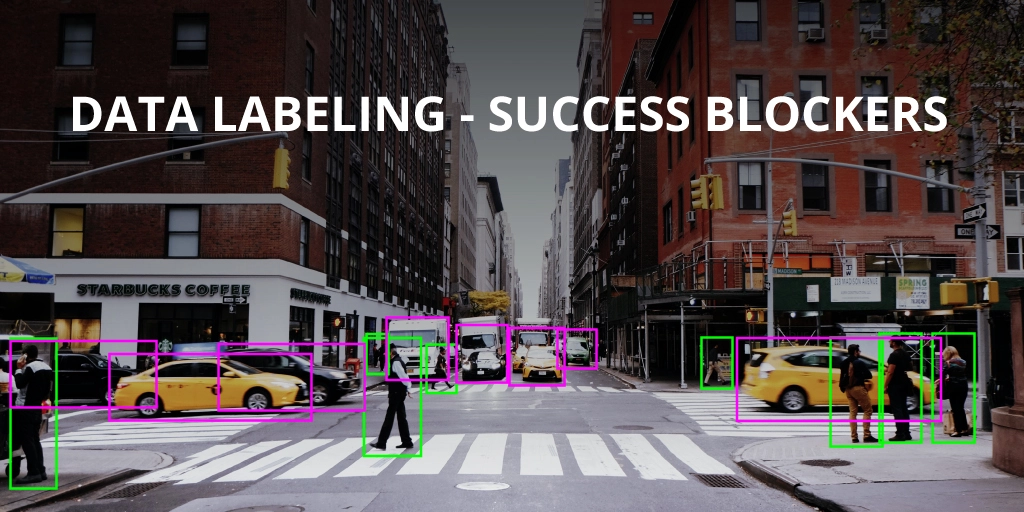
Every model you deploy inherits the judgment of the people who labeled its training data. Architecture gets the attention. Labels decide the outcome.
The six most common data labeling challenges are inconsistent guidelines, poor input data, domain expertise gaps, quality loss at scale, unresolved edge cases, and the trade-off between speed, cost and accuracy. Each is cheaper to fix before annotation starts than after.
Data labeling attaches meaning to raw input so a model can learn from it. A bounding box around a lesion. A sentiment tag on a complaint. A ranking of two responses in a preference pass. The label is the answer key.
The answer key is your ground truth, and the phrase is literal. A supervised model does not learn what is correct. It learns what your annotators said was correct. The same holds for LLM training, where instruction data, preference rankings, and evaluation sets still depend heavily on human labeling.
Label error rates are not marginal. In a 2021 study of the test sets of ten widely used computer vision, NLP, and audio benchmarks, Northcutt, Athalye and Mueller found an average of at least 3.3 percent label errors, including at least 6 percent of the ImageNet validation set. Gartner’s 2020 research puts the cost of poor data quality at $12.9 million a year, and Gartner predicts that through 2026, organizations will abandon 60 percent of AI projects unsupported by AI-ready data.
Inconsistent guidelines mean two annotators give the same input two different labels. Guidelines get written at kickoff, before anyone has annotated a genuinely hard example, so edge cases get resolved in annotators' heads rather than in the document. The model learns the noise with the signal, and the symptom surfaces late, as scores that will not improve however much data you add. Version the guideline, log every edge case with an example, and measure inter-annotator agreement before scaling.
Bad input data is a labeling problem before it becomes a training problem. Teams pull whatever is in the warehouse: duplicates, corrupted files, illegible scans, wrong-language records. Annotators then spend paid hours on records that get dropped, which is the cheap version of the problem. The expensive version survives into training and skews class balance. Profile and clean first. Where the source is unstructured documents, intelligent document processing upstream makes the input worth labeling.
A domain expertise gap is when the annotator does not know the subject well enough to judge the label. General annotators are cheaper to onboard, which is why they end up on content that needs a specialist. A radiology scan, a derivatives contract, a claims denial code: each needs someone who knows the subject. What you get instead are confident, plausible, wrong labels, which a reviewer without the same knowledge will pass. Tier the workforce. In healthcare and finance, that split separates a usable dataset from a liability.
Scaling the annotation workforce solves volume but also creates a quality problem in its place. Every new annotator brings another reading of the guideline, and throughput targets push reviewers from full checks toward spot checks. Accuracy drifts down as the dataset grows, and aggregate metrics hide it until those batches are in training. Build the QA layer before the team: gold standard tasks in the live queue, blind double-labeling on a fixed percentage, per-annotator scores that trigger coaching.
Edge cases are the inputs your taxonomy did not anticipate, and real data is full of them. A photo containing two objects the schema calls mutually exclusive. A ticket that is both a complaint and a feature request. Sarcasm. Annotators guess, and each guesses differently, so ambiguity concentrates exactly where a model needs a clean signal. Give it somewhere to go: an explicit escalate option, a named adjudicator, and a review that turns recurring escalations into new rules. Active learning routes attention there.
Speed, cost, and accuracy pull an annotation program in different directions, and a gain in one usually costs you in another. Deadlines push toward cheap crowd labor or full automation, while accuracy needs review passes that cost time. Choose wrong and you pay twice, because relabeling after a failed evaluation costs more than labeling properly once. Segment by risk instead. Well-defined, high-volume classes take pre-labeling with light review. Safety-critical classes get expert annotation and double review.
That is the shape of Apex CoVantage's data labeling services, run by an ISO 9001:2015 certified company with HIPAA and GDPR aligned controls.
Labeling is one stage in a longer chain. Data collection sets the ceiling, because coverage gaps there cannot be annotated away later. Data enrichment makes raw records usable. Model evaluation runs on labeled data too, so a wrong benchmark makes every model comparison wrong with it. RLHF is where human judgment shapes behavior most directly.
The loop never closes. Models drift, production errors become new training examples, and those need labeling again. As more training data is scraped from an internet full of model output, the human signal gets harder to guarantee. Curated, human-labeled data is the counterweight.
Consistency. Individually, most annotators are accurate. Across a large team on a long project, interpretations drift and edge cases resolve differently depending on who sees them. Most other labeling problems trace back to it.
Companies measure labeling quality three ways: agreement between annotators labeling the same items, accuracy against an expert-labeled gold standard, and per-annotator scores tracked over time. Downstream model performance is the real test, but it is slow feedback.
Partly, and usefully. Pre-labeling, active learning and weak supervision cut manual volume on well-defined tasks. What automation cannot do is resolve genuine ambiguity, apply domain knowledge to an unusual case, or notice that the guideline itself is wrong.
Human review catches the errors a model cannot see. Systematic mislabeling and cases outside the taxonomy look like ordinary data to a pipeline. Human review also produces the audit trail regulated industries have to show.
Better labels produce better models. That argument survives every change in architecture.
The instinct when a model underperforms is to add data. More often the answer is to fix what you have, because a larger dataset with drifting labels teaches the model your inconsistencies alongside your intent. Quality processes outperform simply adding volume. What makes that repeatable is governance, expertise routed where it is needed, QA measured per batch, and feedback loops carrying production errors back into the guidelines.
If your labeling program is hitting any of these six challenges, Apex CoVantage can help you build the workflow around it. Schedule a free consultation with our data labeling team.